Pages

Tuesday, 10 September 2024

RPI 9 - Sharing

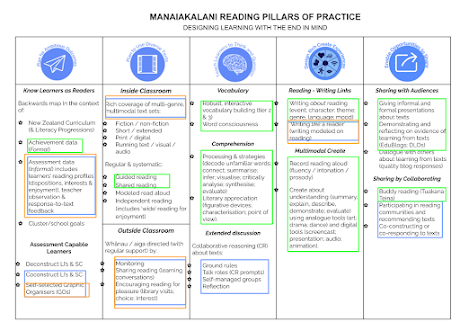
Green is a strength, so they obviously stayed the same. 
Blue was teaching practice to strengthen and integrate.
Orange is now more confident that it is being integrated into my planning and reading. 

So next year I want to have the ground rules and role prompts, 
from the beginning and be referring to them daily, and then weekly. 

Sharing Kaupapa - Fiona

Authentic Audience is important to have Connected learners willing to share. This then helps to deepen learning and experience with the text they read


Edublogs - Holds a record of students learning, reading and other interests

Teachers can gather lots of information from previous years and where students are working at now and previously. We can read alongside and independently to give ongoing feedback.

Share to learn and Share finished learning - not just the finished or polished 

As teachers we can ask - Are you ready to share rather than are you finished?

Participating in Reading Communities

Need to up our game with reading, due to the aim of teaching to the NE, we tend to be in SE quadrant

Include Outside the class to add variety, not just read outside but be creative and act out, use the school grounds, and whanau discussion with students to build a more robust and diverse understanding of what is being read.

Sharing with Audience and Sharing by Collaborating

In Te Mataiaho - Communities - share values/interests - building conversations as communities 

Reach others across motu to make connections and share reading experiences, love of books and comments through Tuhi Mai Tuhi Atu.

The idea of a Blog spot on the group slides - to remind/ indicate what is expected to be blogged that week is wonderful. Along with remembering not everything has to be blogged.

Visible Learning

Blogging has an impact on student learning - engagement, self -expression and higher-order thinking 

Over Summer if students are engaged in reading less slide back as shown in the research from SLJ

Be deliberate about when blogging. - share reading choices, response to text 

Vocabulary task - revisiting enhances learning 

As teachers, we can encourage a peer check to lower the load for us.

Does not have to be finished or perfect - We can add a disclaimer to blogs

Effective descriptive Feedback

We share to reflect on the situation and how it went - 


When we share too often it is hard to receive constructive feedback. Students can pick what they want to receive feedback on, and help the workload.

Students can add a sentence to show they understand Success Criteria, such as I know I will be able to do this when…

These comments and Success Criteria "You looked engaged, stayed in your seat" - are dispositional

We can use Multiple modes of feedback,  

Mahi Tracker - seen, checked dropdown on the comment

Collaboration and Connecting

Reading to (dogs in school) animals non-threatening 

Commenting and Responding in not linear or a neat/clear cycle 


  • “The future is not some place we are going to, but one we are creating. The paths to it are not found, but made; and the activity of making them changes both the maker and the destination.”

  • — Peter Ellyard


Sharing with Whānau

How do we share reading challenges with Whanau - Notice Board 

When using Culturally related text - ask the family if they know about Tafoe or Hoe

Response to text or part of Reading Challenge

Send a map if the library is local

Invite parents to author visit or book a day

Invite whanau to share myths legends

Next Steps

  • Create a space - main kete
  • Checked out a couple one with choice of course- emulate


RPI - Reflection

 We are approaching the end of the RPI, and the best question is:

 How are we going to maintain the RPI Kaupapa?

Like all teachers, I have a dream ...

Currently, to make my life easier I have a set of Vocabulary slides with various activities on and I add this to the Response to text slides, once we have a set of words both teacher selected and student selected I choose an activity that best fits the needs of the students. 

Some groups, I get them to select the slide and they can use it like a template to modify and create their own.
   

 These students will report back to the larger reading group later in the week. My reading groups have around 8 and break into pairs for the reading response activity. 

I also want to do this for the graphic organisers for the Figurative Language, just for quick reference. First, I will need to modify and possibly make them into slides for they fit nicely into response activities. Will see how this could work.

Next Steps

Creating a site with the headings:
  • Vocabulary
  • Summarising
  • Evaluating
  • Main Ideas
  • Making Connections 
  • Inferring
  • Point of View
The site has a range of digital and other activities, that cater to a range of abilities. Allowing everyone to use references. 

Tuesday, 20 August 2024

RPI 8 - Create

 Create Kaupapa

Dorothy was sharing with us today how Crete is a valuable aspect of the whole Manaiakalani Approach. The best part is we can all be creative in our own way, it doesn't matter if we 'can't draw as well as' That Guy.
Even better still, it's a great way to engage with others, in the class and around the motu.


The digital affordances allow everyone to be creative, just be mindful of AI content generators. Their interpretation and the author's meaning don't often match but can open up ideas for discussion.

Why Creativity is so Important

Students bring their own voice, and interpretation to what they are doing, and as it engages both the cognitive and emotional sides (and all senses) of the brain people are fully engaged = GOOD READERS.


Create to Show Learning

There are many ways to create digitally and students who think it is all about art can relax, using digital tools means we can use our bodies to dance, sound/voice, and tactile (clay, paint, follow instructions).
Making things routine is easier for students (and teachers) to complete as they know the expectations, and they can be done anytime during the reading.

Students can do short creative tasks with tighter instructions with restricted choice and constraints, looser instructions, still with constraints but less, once they are more experienced in the teacher's expectations and the digital affordances.
Stencils are reusable for different texts but allow for student creativity and collaboration. Just like traditional stencils, they are timesavers that give students the ability to succeed. Helping them to focus on higher-order thinking (HoT)
They can even have multiple creates for one text, using different tools.

One-shot Film

Fiona spoke about One-shot Films, with her years of experience and film-making this is a simplified version, One minute one shot to share the book/novel you are reading and why it is a good read for someone else. I did a couple ...


As we talked about in T-Shaped Lit discussions, Students can read, present and add reflections to their videos, WWW: What worked, What would you do next time, What do you need help with or What did you notice, What do you wonder ...

My reflection is more of a reminder - SMILE (Even if you would rather be behind a camera)

And if they do it vertically they can make it into a fake tiktok video. I didn't notice that iMovie had a feature that rotates video, which is also helpful if students are using Chromebooks to record.

Where to Next:

  • Record with students, Record Students, Record Discussions
  • RECORD RECORD RECORD

Tuesday, 30 July 2024

RPI 7 - Thinking

 Before we even started today we went through some of the tasks we had completed from Day 6, I found some interesting ideas I want to use. Thank you, Rochelle.


I am proud of my Magpie Wall - I love to colour code things, which I did with my word wall. We are currently reading The Maze Runner it has made-up words Neologisms (dark green), and words that can be used in other stories and books (cream) and we are looking at STEAM which has different words, mostly technological or technical terms. 

I also found it sad to realise we are coming to the end of RPI, (well, 2 more sessions) It doesn't feel that long ago we embarked on this journey. I thought oh far out I have 8 more days like this and now it feels like it will be over all too soon.  It would be great to have the opportunity to get together next year and see how we are going, what is working and what we need help with...

Connecting with Dorothy - Smart Thinking for Smart Learners

We must teach students to make decisions while reading so they can analyse and evaluate what they read. Here are a couple of ways we can do this...

Students need to be critical thinkers in the digital world as AI becomes used more and deep fakes harder to spot. We can also do this with the Cybersmart Programme through Manaiakalani - Smart Learner and Smart Media, teaching lifelong skills and habits. Such as, How to evaluate what images they see or what they read or listen to, checking reliability and the purpose of what they find online.

A few resources Dorothy eluded ways to include hoax websites and news, helping kids understand disinformation and misinformation.

The other useful tool Dorothy talked about was the Adobe Express tool for podcast recording and how it is editable through the transcript. - Even better, you can create a class to see how students progress with their tasks.

Higher Order Thinking

It was mentioned how we always tell students to show not tell in their writing so the reader can engage their brains as they read, and try and solve the mystery of what is happening before it happens.

We must teach evaluative and interpretive questions and how to answer them to empower students.
Evaluative Questions ask students to make a judgement, (e.g. which is better or worse) and justify their reasoning. 
Interpretative Questions require students to use what they know and information from the text to explain why they have a different interpretation than their peers.

Analysing Text

There are many ways to analyse text. Three common ones used in school are...
I have used all three throughout my teaching and know they all have their benefits. I love the hats as you can use hats as reminders on student laps and it was the first one I ever got my head around.
Most recently (the last 10 years) I have been using SOLO, and as I was reminded recently it is what High Schools use and we want our Year 7 & 8 Students prepared for success.

Bloom's Taxonomy is useful when I need words for Learning Intentions, and Success Criteria and need a Verb to describe precisely what I want students to do. It was wonderful to see Bloom's has a new layer of Creating. This video is useful to understand the different aspects of Bloom's Taxonomy.


Kiri also talked about how we can zoom in to focus at the word level and zoom out for evidence of the big idea the text is sharing.

Figurative Language

We can zoom in and out on Figurative Language helping to develop meaning. It is vital to teach students what similes, metaphors, hyperbole, and anthropomorphism are (along with other figurative language). We don't want students to go around pulling someone's leg just because they heard a teacher say why don't you 'pull the other one'.

Critical Analysis - Perspectives

Perspectives - interpreting perspectives, needs a provocation - can’t be one that everyone agrees with - or you can play devil's advocate. These are great for extended discussion. If a shared text you can share the provocation and students can discuss in table groups and report back.


Again we need to teach students how to disagree with each other. We are challenging the idea, not the person. Dialogic - let's weigh up the options is a better term than persuasive - bullies are persuasive!


Critical Analysis - Positioning

This looks at agendas, political, and social constraints or constructs, religious views, race or gender bias ...
Language is not neutral. When reading we can see what bias the author might bring, as readers we also bring own ideas. This is where text sets can help bring in different ideas and perspectives.

Teaching Synthesis - Skill Builder

Synthesising - We first started talking bout this when T-Shaped Literacy came out, with these Resource Room Activities- which include a video on screencast on modelling analysis by a student

Where to Next?

  • Using Adobe to record practise presentations before students do the final presentation
  • Encouraging students to go to the next level with their presentations to include synthesis and analysis.

Tuesday, 18 June 2024

RPI 6 - Vocabulary and Decoding

 Connecting with Manaiakalani

Once again Dorothy had lots of wonderful knowledge and tidbits.

Low-demographic students can miss 32 million words before they enter school, which is a huge amount to pull back.

However, I like that teaching vocabulary allows students to open doors. One of the easiest ways to do this is by reading to our children and students. Even newborns who can't open their eyes enjoy listening to familiar voices as that is how they connect with family from the womb.

I want to check out a few apps to help build a game-like challenge for students. Students from my class have been reflecting on other choice boards and asked: "Why don't we have more game-like activities in reading and writing?"
It was pointed out that Wordwall is a user pays.

I also like when the teacher doesn't have to make them all. Especially teaching Year 7 and 8 students love to be creative, making their own and sharing with others, shows what they know. However, I would spend the first term giving examples of what was expected.


Dorothy also reminded us about using smart chips (dates, people or map locations) and dropdowns. Providing students with an interactive Google Doc or opportunities to identify words by highlighting/finding specific words, such as verbs makes this achievable for struggling students.

Background Knowledge

Naomi's idea 'We can't think without words' placing vocabulary at the top of the ' Teach Learner to Think and Question Pillar'. While students may learn to decode and read text, they must grasp that letters form words and words convey ideas. With this understanding, they might make the necessary connections between decoding and comprehension.

 Low oral vocab is the reason for many of students issues with reading. So we need to be on target.
Allowing Learners the opportunity to rate their understanding of vocabulary in a story is a great self-assessment and then reassessed at the end of the week. It is also easy to reproduce for any text, as these are the ones I can see being used and students can become familiar with and be proud to blog about as they show progress.

I have been that teacher, overusing one or two activities (define, find synonyms/antonyms) and if I'm bored after a few weeks it can't be good for students. Although I used to use define as a dual purpose (understanding and dictionary skills).

Word Consciousness

I like the idea of being word-conscious, as an avid reader I find it fascinating when I come across a word I have heard but not seen and hear students use specific words or technical words my heart flutters.


Hearing them use intricate words is empowering for them and as a teacher.


As a reader, there are survival words that students need to understand or the text won't make sense, so it is important to teach them and expose words to students before reading.

Since COVID-19, I have been doing Rebus Puzzles with students to build understanding of word puzzles. I love the fact that to understand them students need to infer. Students were even explaining why or how they worked them out reinforcing their understanding or point of view and helping others to work them out next time, as we often found similar puzzles at different times.


Explicit, Robust Vocabulary Learning Opportunities

For this to work we need to know which words to focus on. In teaching Years 7 and 8 most students recognise the high-frequency words.

This image is unclear but I appreciate the sample of Tier 2 words given. E.g. hilarious, endure, despise, arrange, compare and contrast.

Whereas Tier 3 is content or job-specific. An electrician would know 'reactance and relay' but a doctor might not. And a doctor would know 'immunosuppressed and oedema', whereas an electrician may not.

Tier 2 words are important as they don't come up in conversation often but impact student understanding of the text. Try to focus on 5-8 words a text.


Cracking Unfamiliar Words

Papakura Achievement Initiative (PAI 2005-2015), schools in Papakura focussed on Literacy,  and part of that was through Joy Allcock's Switched on to Spelling. With my previous experience with Jolly Phonics, I got the consonant-vowel patterns. This was a good reminder to revisit this with struggling readers to identify sounds they find tricky so they can identify patterns and work out words giving them independence with reading.
Time needs to be scheduled so it becomes part of the teaching programme not hit and miss. Deliberate Teaching!

Skill Builder - Questioning

Shared understanding helps students discuss and consolidate information. This can be achieved by using focused questions.

Where to Next?

  • Sharing the spelling programme (The Code) as it goes from Year 1 to Year 10 and we are looking for a schoolwide programme.
  • Using some if not all of Dorothy's ideas for spotlighting words in text such as dropdown and smart chips.
  • Magpie Window/Wall or Word Wizards (on a window) as I have limited wall space. I also have mobiles I can hang for specific words (better words) that I need to dig out.

Saturday, 15 June 2024

RPI - Reflection on Task Board & Timetabling

 Task Board Rejigged

I have adjusted my timetable, I have a group I need to see daily which limits the time they have for choosing as they are still expected to get the reading response completed. 

So I created a simpler taskboard with a spot for fast finishers rather than extra for experts. I think the reason for the title is self-explanatory. However, I have explained to students that fast finishers do quality mahi.


The other groups I see twice a week still but once is a 5-10 minute check-in to check they know what they are doing with the reading and reading response. (A great time for students to seek clarification). I have also added this timetable and have the links to group pages, which has helped me move efficiently from one group page to the next without having to return to the home or main reading page. (links to reading page - to see in action). Currently, you can see I have a bit of room for testing with reports looming, but this will change again shortly to 1:1 conferencing for students who want more individual help or a question they don't want to ask.


I have been looking at ways to help another teacher and how we can simplify a Maths task board. One thought I came up with was having 2 one for 'Must-do' and 'Choice' and the other for group work. They would sit beside each other on the class site so students are in one place to find all the work.


Student Responses from My class about the Choice Board - 

With a group task board next to it, on the class site (group page) that could look like this with more detail and links to the learning. This second part is only a rough draft.

Wednesday, 12 June 2024

RPI - Reflection on Great Beginnings

 Reading to Write and Writing to Read

I love this concept. As a person who has dabbled with writing, I love reading novels and seeing how they have constructed their ideas. How authors have used similies, personification and onomatopoeia along with other literacy features we teach in the class. Now students can start their narrative with the problem rather than build up to it.

I have used writing frames before and it is great to know I can come up with my own, using what others have written. 

The timing for this task was wonderful as we were about to revisit narratives. I also like how you can use this particular frame to pose questions to bring suspense and the issue to the forefront of the story.

I introduced the story with one group from the class but used the frame with the whole class. Next time I will introduce the story to other groups and use that frame with the entire class. This way they can all see how the process works.

We have in fact just received our Duffy Books and I was looking at one called Last Chance, it starts with asking the reading 5 things that can not stand.

My example using this writing Frame:

The mountain was silent from up here even though it was early afternoon.  The only sound was the faint whirring of the helicopter blades in the distance. The ravine loomed before us fresh snow hung in the air as my closest friend chomped at the bit. Will we make it?


My Challenge now is to create more writing frames - We have been looking at Report Writing, and I realise I could have created one for students to write the general statement and possibly the first paragraph.

The final thought I am sharing with my class is how they too can be magpies and use stuff others have written and change it to make it their own. Text is often woven from other sources, taking words, phrases from text, and people and using them as part of their creation.


The idea of adding these ideas, words, phrases to a Magpie Wall so all can see and use them later is a wonderful of sharing.


Did you know Writers are robbers?


Am I returning to class on air days? Here is how I introduced suspense during reading and took it into writing.


I look forward to creating the poster for Great Beginnings with my Year 7/8 students after the discussion where they were sharing parts of books where they could recognise the suspense.
  1. They have great ideas that other students can be inspired by and through
  2. Students will understand the chart's purpose and how to use it with clarity.

Saturday, 8 June 2024

TOD - Local Curriulum @ Papakura Marae

Today, the focus was on bringing Local History Alive for us and our students through activities we can use in our class. 'Ko au ko Papakura, Ko Papakura ko au' is our theme for the year and we are teaching the students about their place and role in Papakura and having kaitiakitanga in our place.

Telling the stories of the Wharenui, TeNgira
It all started with an email ensuring teachers who were attending knew the protocols for visiting a marae. This was helpful even though I have visited a couple before, but understanding the Kaupapa behind what we were doing was wonderful and a chance to practise and know the songs we needed for the powhiri. 

When we teach, in the classroom, we share with students the purpose of the learning to help their understanding and this was the same, for those of us who have not been brought up on a marae. 

We started with a Powhiri. The tangata whenua then shared the history of the pou (the specific carvings and art pieces surrounding the Te Ngira) and how their role as guardians helps everyone feel they belong. This is what we want students to be able to do, share their stories with pride (poho kererū).

I have previously visited this marae with students, while I was teaching at another school and we had the opportunity to participate in different activities.

Today there were three workshops: 

  1. The other part of Pukekiwiriki, with housing in between.
    Pukekiwiriki, a hikoi up the Maunga to the Pā site with Wiremu and Hemi to hear the rich stories of the kumara pits and the richness of the area (EHS did this during the previous holiday, which I was grateful for as we ran the other workshops).
  2. Maara Kai, Aunty Mā and Kristal shared their expertise on the history and planting, in conjunction with Maramataka Māori and the history of hākari (feast of years past). It can also be culturally responsive to the needs of our students as it is related to their current knowledge and makes connections with the land.
  3. Purākau o Neherā, digitally telling our narrative using Storyboard That, Canva and Book Creator as the specific apps. Tools we were already using showed others the possibilities they can take back and utilise in class.
Hunua Ranges from Pukekiwiriki.

Before the term started we went on our own hikoi, wondering how many of the students had been up the maunga. It was a nice way to catch up and understand our theme, as I started into Term 1. I could see the connections back to Mangere, as I have been up there multiple times with schools and found many connections back to the information and people. The kumara pits, the Maramtaka, the fertile soil and the Maara Kai. 

Where there is kai there must be water. We could see the Hunua Ranges and thoughts of the dam came to mind, the flowing of water down to local streams, possibly behind the marae or the Hayes Stream. 

All of this fed into our topic for Term 2, some levels picked up on the water cycle and waterways and utilising science experiments to develop student understanding and ways to preserve water. We went with erosion and how water can affect the land we live on, Climate change, and the impact on the environment as we could see the quarrying from the maunga.


Kumara Pits.

View to the East with the Kumara Pits.


It was fascinating to listen to the history of the area I have lived in for over 20 years and spent most of my teaching career here. 

Much appreciate the knowledge of our Principal and Staff at Edmund Hillary and their willingness to share. Without this Kaupapa people will continue to feel lost.

Thursday, 6 June 2024

Toolkits - Term 2: Google Admin

 Thanks Jeremy, we have come from a similar place. I confirmed that what I was doing was an extension of the scope of my digital role. 

He had a few tips for the Organisational Units and ways to keep these in check, leading to a discussion on actions for when students and teachers leave. 

What should happen to their accounts? This I found interesting as I am setting up resources for teachers to use today and looking forward and if my account is suspended, all that work would be useless. 

All accounts should have passwords changed and moved to the leavers OU. 

This prevents deleting and access when it is no longer required. Something Manaiakalani is very staunch about!

Wednesday, 5 June 2024

Toolkit - Term 2: Te Reo for the Akomanga

 A couple of my favourite I want to take straight back to class and use are

Āta whakarongo mai - āta meaning to me

Kei te marama tātou? Ke te pai?

He pātai tā tētahi? Questions?

Kūjara - Google

Tāruatiā - Make a copy


When I stepped out of the class, I needed new phrases for that role, and lost my confidence. Now, back in the class, I have noticed especially after going through these (many I knew). I am hearing myself say more and more Yah!

Monday, 3 June 2024

RPI - Reflection on Guided Reading Process

 To improve my Guided Reading Lesson, 

  1. I will focus on sharing the learning intention, as I can be hit and miss with this and the purpose behind the learning intention, and reading responses or follow-up activities are related to these. 

With all students the purpose or reason for learning is important but I have found it even more so as students are older. It helps students engage as they too can see the purpose behind what they are learning and how it applies to life (which gives it meaning outside the classroom). 

Regardless of how time-poor I feel, students are more engaged providing more focused learning time and better results.

      2. Sharing how to be successful

We all like to be successful and the best way is to know what to do next, how did we get through Uni, by knowing what was expected and when it was expected, 


      3. Being quiet, giving students time to respond.

Manaiakalani observes teachers, as part of this they look for students interacting with students, or extended discussions, (without the teacher directing or forcing the conversation). Again as I am teaching older students they don't need me to fill in the gaps of discussion, and silence, they may occasionally need discussion scaffolds, but that doesn't mean I answer.
     
      4. Prior Knowledge Activation or Activites.
Again is this because they are older students, I often forget to have a discussion on what students know about the text and dive in. However, this is important for students who are struggling readers or writers and this discussion or activity can help them focus in on what they are about to learn. 

I see it happening at home one minute we are talking about my boys' rugby and the next it is the national teams and I am lost and wondering why I have to be at a game at 7pm at night. All because a couple of words have been missed in the conversation and assumptions are made.

Post Grad Pt2: W3 Innovation Ideation and Prototyping

Whakataukī He iti hau marangai e tū te pāhokahoka Just like a rainbow after the storm, success follows failure Why you should and how you co...